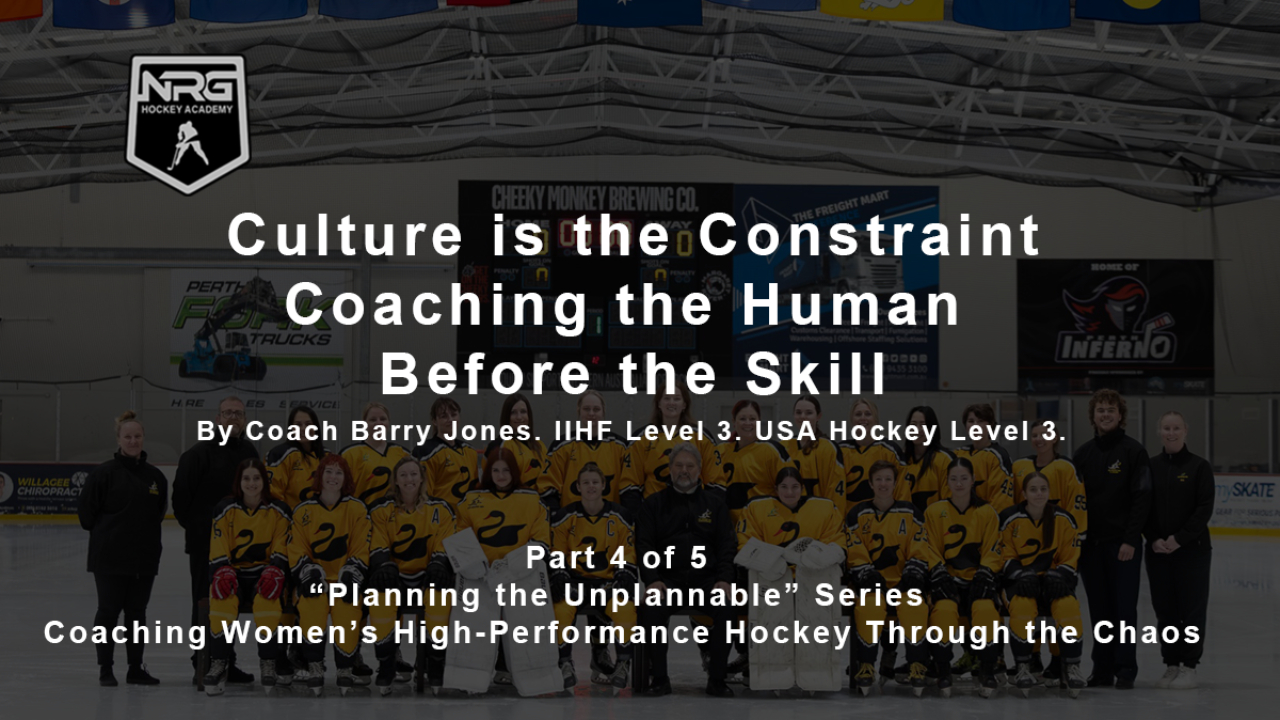
Inside the Constraint: You Are What You Train 1:8
By Coach Barry Jones | IIHF Level 3 High Performance | USA Hockey Level 3 Performance
Full set of articles in this series:
- Inside the Constraint: You Are What You Train (1:8)
- Inside the Constraint: You Don’t Rise to the Occasion (2:8)
- Inside the Constraint: Designing Behaviour (3:8)
- Inside the Constraint: Developing Coaches (4:8)
- Inside the Constraint: Building Systems That Last (5:8)
- Inside the Constraint: Environment to Outcome (6:8)
- Inside the Constraint: Beyond Geography (7:8)
- Inside the Constraint: The Level 5 Standard (8:8)
We’ve All Heard It Before
“Athletes don’t rise to the occasion, they fall to the level of their training.”
It’s a great quote. It sounds right. It gets repeated in dressing rooms and coaching clinics all over the game.
But it’s incomplete.
Because it assumes training is just repetition. It assumes that if we do something enough times, it will hold under pressure.
In reality, players don’t fall to their training.
They express it.
Manifestation Without the Magic
There’s a lot of noise around manifestation right now. Visualise success, believe hard enough, and outcomes will follow.
That’s not what this is.
Manifestation, in a coaching sense, is not about belief. It’s about behaviour.
You don’t become something because you say you are. You become it because you repeatedly act in alignment with it.
Identity isn’t declared. It’s constructed.
So if you design better environments, think deeply about the game, develop players and coaches, reflect, adjust, and evolve, you don’t just act like a high-performance coach. You become one.
You Are What You Train
If identity is built through behaviour, the next question is simple: where do those behaviours come from?
The answer is the environment.
Training isn’t just what we do. It’s what the environment demands.
If your training is predictable, scripted, and low pressure, players learn to execute patterns, rely on structure, and wait for instruction.
But if your environment is information-rich, variable, and decision-driven, players learn to scan, adapt, and solve.
Under pressure, they don’t search for answers. They act from what they’ve learned to see.
From Players to Coaches
This doesn’t just apply to players. It applies to us.
If I want to become a Level 5 coach within USA Hockey, that’s not a title I wait for. It’s a standard I work toward.
They don’t just run sessions. They design environments. They develop people. They contribute to the game.
That means studying human development, exploring new coaching approaches, mentoring other coaches, sharing ideas, and building systems that last.
Environment Builds Identity
Over time, something shifts.
You stop trying to become something and start operating as it.
Because the environment you place yourself in shapes how you think, act, and respond.
We don’t tell players to be adaptable. We build environments that require it.
So why would it be any different for us?
The Constraint Is the Point
Every environment is a constraint. It limits certain behaviours and invites others.
Constraints are not restrictions. They are tools.
The space you design, the time you allow, and the pressure you apply shape what the athlete perceives and how they act.
Over time, those actions stabilise. That’s where identity lives.
Closing Thought
You are not manifesting outcomes.
You are constructing identity through behaviour.
And behaviour is shaped by the environments you build and the constraints you apply.
So if you want to change performance, don’t start with motivation. Start with the environment.
Because in the end: You are what you train.
What Comes Next
If training environments shape behaviour, and behaviour shows up under pressure, then the next question is: what actually happens when the pressure hits?
Author Bio
Barry Jones is an IIHF Level 3 High Performance Coach and USA Hockey Level 3 Performance Coach. His work blends ecological dynamics, nonlinear design, and athlete-centred leadership to build adaptive teams that thrive in uncertainty. He is also the developer of Task Sketch, a tool designed to support coaches in creating game-representative training environments.