Helping athletes discover how changing the movement changes the solution
By Coach Barry Jones
IIHF Level 3 High Performance | USA Hockey Level 4 Performance
In Part 2, we explored four simple spatial relationships:
UNDER. OVER. AROUND. THROUGH.
The idea was not to give athletes four techniques.
It was to give coaches a scaffold for creating problems while leaving room for different movement solutions to emerge.
But finding a solution is only the beginning.
Once an athlete discovers that they can get a puck OVER a stick, for example, another question appears:
How many different ways can OVER work?
This is where exploration can become calibration.
The athlete isn't simply learning a movement anymore.
They're beginning to learn how changing the movement changes what happens next.
From Finding It to Shaping It
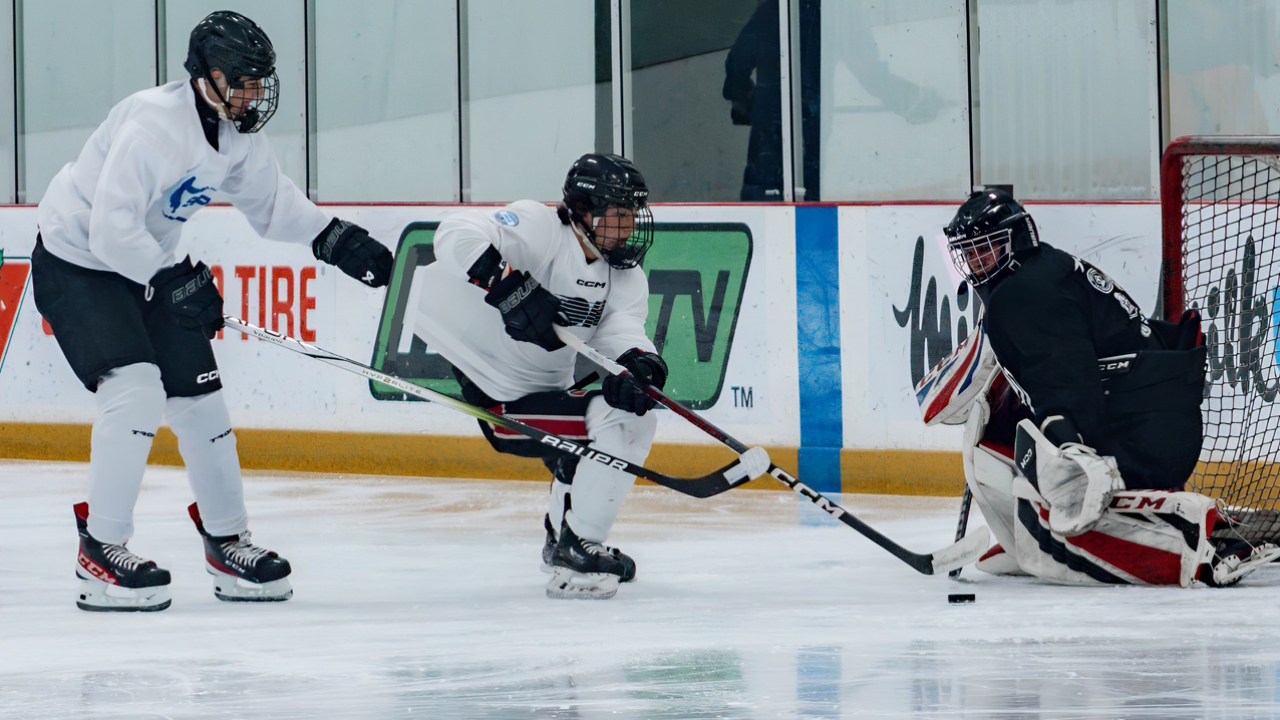
Imagine an athlete has discovered they can chip a puck over a defender's stick.
We could immediately step in and refine the technique.
Show them where to position their hands.
Set the blade angle.
Demonstrate the height we want.
Repeat it until it becomes cleaner.
Sometimes that may be useful.
But there is another opportunity first.
What happens if we let the athlete manipulate the movement and experience the effects?
Higher stick position.
Middle.
Lower.
What changes?
Perhaps one sends the puck higher.
Another creates more distance.
Another produces a flatter trajectory.
Maybe the results aren't what either the athlete or coach expected.
That's the interesting part.
The athlete isn't just being told what each movement should do.
They're experiencing the relationship between what they change and what happens.
That's calibration.
The Three Solution Principle
I've started using something I jokingly call the Three Solution Principle.
It's not a scientific theory.
It's simply a coaching scaffold I use to stop myself from jumping too quickly from discovery to correction.
Once an athlete finds a workable solution, I invite them to explore three versions of it.
For example:
Can you find three different ways to get the puck OVER?
Or I might manipulate one variable:
Try it with your stick higher.
Try it from the middle.
Try it lower.
Then I ask:
What changed?
The purpose isn't to secretly guide them toward the one version I've already decided is correct.
It's to create contrast.
If every repetition feels the same, there may not be much information for the athlete to compare.
When we deliberately create differences, the athlete can begin connecting action and effect.
Repetition With Difference
Athletes still need repetitions.
Calibration doesn't remove repetition.
It changes what we're asking the athlete to repeat.
Instead of:
Repeat this movement ten times.
We might create:
Ten opportunities to solve the same problem with slightly different information.
The puck still gets touched repeatedly.
The athlete still gets time on task.
But now each repetition can tell them something.
Too high.
Too low.
Too far.
Not far enough.
Fast.
Slow.
Available.
Blocked.
Successful.
Unsuccessful.
The repetition contains feedback from the outcome itself.
That's where the environment can start doing some of the coaching.
Don't Correct Too Quickly
This is probably the hardest part for many coaches, myself included.
We see something we could fix.
And coaching has traditionally rewarded us for fixing it.
The athlete tries something awkward and we immediately have an answer.
Move your hands.
Open the blade.
Change your feet.
Do it like this.
But sometimes the movement we're about to correct is actually the athlete collecting information.
An unsuccessful attempt can reveal something.
The puck went too high.
The defender recovered.
The angle disappeared.
The puck travelled further than expected.
If we immediately replace that experience with our solution, we may remove the opportunity for the athlete to connect their action with the result.
So I've started asking myself:
Does this athlete need correction right now, or do they need another repetition with information?
Those are not always the same thing.
Invite the Effect
This has also changed some of the language I use.
Instead of always describing the movement I want, I can describe the effect.
Can you make it travel further?
Can you keep it lower?
Can you get it over without giving the defender time to recover?
Can you make the same movement create a different outcome?
Now the athlete has something to organise around.
I know some of the movement solutions that might create those effects.
But I don't necessarily need to give them away immediately.
Invite the effect before naming the technique.
The environment gives the athlete a problem.
The athlete changes something.
The outcome gives them information.
Then they adjust again.
Calibration Isn't Perfection
This distinction matters.
Calibration isn't a process of slowly moving every athlete toward one perfect technical model.
It's helping athletes become more sensitive to the relationship between their movement and its effect.
A solution that works for one athlete may look slightly different for another.
The useful question isn't always:
Did it look right?
It might be:
Did it produce the effect you needed?
And then:
Could you reproduce or adapt that effect when the problem changed?
That's a much richer form of skill.
The movement isn't valuable because it looks like the demonstration.
It's valuable because the athlete can use it to solve something.
Explore, Calibrate, Apply
I've started thinking about this process in three simple stages:
EXPLORE.
Find possible solutions.
CALIBRATE.
Manipulate them and learn what changes.
APPLY.
Put them back into a problem where the athlete has to recognise when that solution might be useful.
That final step matters.
If we spend time removing information so the athlete can explore the movement more closely, eventually we need to put information back.
Pressure.
Timing.
Space.
An opponent.
A decision.
Otherwise, we may develop a beautifully calibrated movement that the athlete still doesn't recognise when the game asks for it.
Take It to the Ice
At your next practice, find one moment where an athlete discovers a workable solution.
Before correcting it, try something different.
Ask them to create three versions.
Change one variable.
Height.
Distance.
Speed.
Angle.
Stick position.
Then ask:
What changed?
Let the athlete experience the difference before explaining it.
You're not abandoning technique.
You're creating information that can make the technical conversation more meaningful.
Because sometimes the next step after discovering a solution isn't immediately making it perfect.
It's helping the athlete understand:
What can I change, what effect does it create, and when might I need it?
That's calibration.
Coming Next: When Exploration Gets Stuck
Exploration doesn't mean athletes must discover everything for themselves.
Sometimes they get stuck.
Sometimes a useful movement doesn't emerge.
Sometimes the coach has information that can help.
In Part 4, we'll explore when to narrow the problem, when to demonstrate, when blocked practice can be useful, and how to provide enough information to restart exploration without taking ownership of the solution away.
Barry Jones is an IIHF Level 3 High Performance Coach and USA Hockey Level 4 Performance Coach. His work blends ecological dynamics, nonlinear design, and athlete-centred leadership to build adaptive teams that thrive in uncertainty. He is also the developer of Task Sketch, a tool designed to support coaches in creating game-representative training environments.